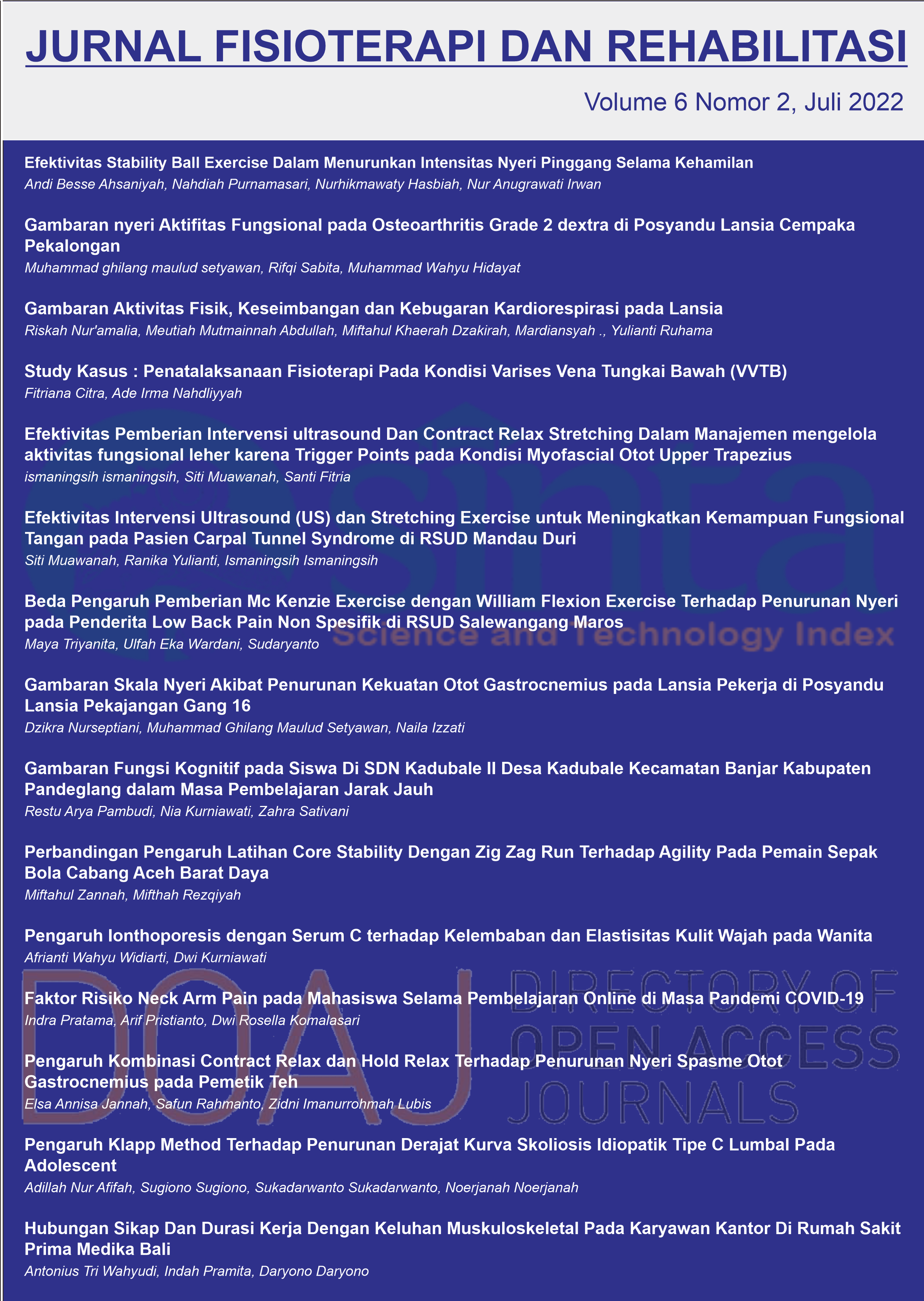
Gambaran Fungsi Kognitif pada Siswa Di SDN Kadubale II Desa Kadubale Kecamatan Banjar Kabupaten Pandeglang dalam Masa Pembelajaran Jarak Jauh
Abstract
Pembangunan Kesehatan anak merupakan salah satu tujuan nasional, emosional, psikologi dan masalah belajar termasuk aspek penting dalam Kesehatan anak, masalah belajar dengan keterkaitan performa akademik menjadi perhatian penting karena memiliki implikasi di masa mendatang dalam kualitas hidup. Tujuan dari penelitian ini adalah memberikan gambaran dampak pandemic COVID-19 yang berpengaruh pada fungsi kognitif pada siswa karena pembelajaran yang dilaksanakan secara jarak jauh. Dan gambaran fungsi kognitif pada siswa SD terkhususnya yang berada didaerah dengan tingkat sosial ekonomi rendah, penelitian ini dilaksanakan di SDN Kadubale II yang terletak di desa Kadubale Kecamatan Banjar Kabupaten Pandeglang. Metode penelitian adalah dengan metode deskriptif, dilaksanakan pada bulan September 2021 dengan melakukan pemeriksaan fungsi kognitif pada siswa SDN Kadubale II. Dari penelitian ini diperoleh 21 sampel yang terdiri dari 9 laki-laki dan 12 perempuan, berdasarkan usia terdapat 2 kategori yaitu 9 dan 10 tahun. Hasil pemeriksaan Digit Span Test ditemukan perbedaan yang signifikan terhadap hasil terendah dan hasil tertinggi pada percentile equivalent, sehingga disarankan adanya penyusunan yang mengedepankan fungsi kognitif seperti melakukan kegiatan diluar pembelajaran pokok seperti aktifitas fisik yang dapat menunjang peningkatan fungsi kognitif.
References
Basso, J. C., & Suzuki, W. A. (2017). The Effects of Acute Exercise on Mood, Cognition, Neurophysiology, and Neurochemical Pathways: A Review. Brain plasticity (Amsterdam, Netherlands), 2(2), 127–152. https://doi.org/10.3233/BPL-160040
Brauer, S. G. Wollacott, M. Sumway-Cook. (2001). The Intercating Effects of Cognitive Demand and Recovery of Postural Stability in Balance-Impaired Elderly Persons. J Gerontol: Med Sci. 56 A(8): M489-96.
Dahlan, M.S. 2008. Statistik untuk kedokteran dan kesehatan. Jakarta: CV.Sagung Seto
Horak, F (2006). Postural Orientation and Equilibrium: What do we need to know about neural control of balance to prevent falls?. British Geriatics Society.
Isaac, V. Sim, S. Zheng, V. Zagorodnov, E. Shyong Tai. Chee, M. (2011). Adverse Associations Between Visceral Adiposity, Brain Structure, and Cognitive Performance in Healthy Elderly. Frontiers in Aging Neuroscience. 3(12).
Khadijah. (2016). Pengembangan Kognitif Anak Usia Dini. Medan: Perdana Publishing.
Khan, N. A. Raine, L, B. Donovan, S. M. Hillman, C. H. (2014). The Cognitive Implications of Obesity and Nutrition in Childhood. Monographs of the Society For Research in Child Development.
Lara, S. et al. (2018). Association between Postural Balance and Anthropometric Indexes In Elementary Schoolchildren. Rev Paul Pediatr 36 (1): 59-65.
Prasetiowati, L. Kusumaningtyas, S. Tamin, T. (2017). Effect of Body Mass Index on Postural Balance and Muscle Strength in Children Aged 8-10 years. JKIMSU. Vol. 6, No. 2
RISKESDAS. (2013). Riset Kesehatan Dasar Tahun 2013. Jakarta: Badan Penelitian dan Pengembangan Kesehatan.
Sartika, R. A. D. (2011). Faktor Risiko Obesitas Pada Anak 5-15 Tahun di Indonesia. Makara. 15 (1): 37-43.
Sastroasmoro, S. & Ismael, S., 2010. Pemilihan Subyek Penelitian Penelitian : Dasar-dasar Metodologi Penelitian Klinis. Edisi ke-3., Jakarta: CV Sagung Seto
The use of the article will be governed by the Creative Commons Attribution license as currently displayed on Creative Commons Attribution 4.0 International License.
Author’s Warranties
The author warrants that the article is original, written by stated author(s), has not been published before, contains no unlawful statements, does not infringe the rights of others, is subject to copyright that is vested exclusively in the author and free of any third party rights, and that any necessary written permissions to quote from other sources have been obtained by the author(s).
User Rights
JFR's spirit is to disseminate articles published are as free as possible. Under the Creative Commons license, JFR permits users to copy, distribute, display, and perform the work. Users will also need to attribute authors and JFR on distributing works in the journal.
Rights of Authors
Authors retain all their rights to the published works, such as (but not limited to) the following rights;
- Copyright and other proprietary rights relating to the article, such as patent rights,
- The right to use the substance of the article in own future works, including lectures and books,
- The right to reproduce the article for own purposes,
- The right to self-archive the article
Co-Authorship
If the article was jointly prepared by other authors, any authors submitting the manuscript warrants that he/she has been authorized by all co-authors to be agreed on this copyright and license notice (agreement) on their behalf, and agrees to inform his/her co-authors of the terms of this policy. JFR will not be held liable for anything that may arise due to the author(s) internal dispute. JFR will only communicate with the corresponding author.
Miscellaneous
JFR will publish the article (or have it published) in the journal if the article’s editorial process is successfully completed. JFR's editors may modify the article to a style of punctuation, spelling, capitalization, referencing and usage that deems appropriate. The author acknowledges that the article may be published so that it will be publicly accessible and such access will be free of charge for the readers as mentioned in point 3.