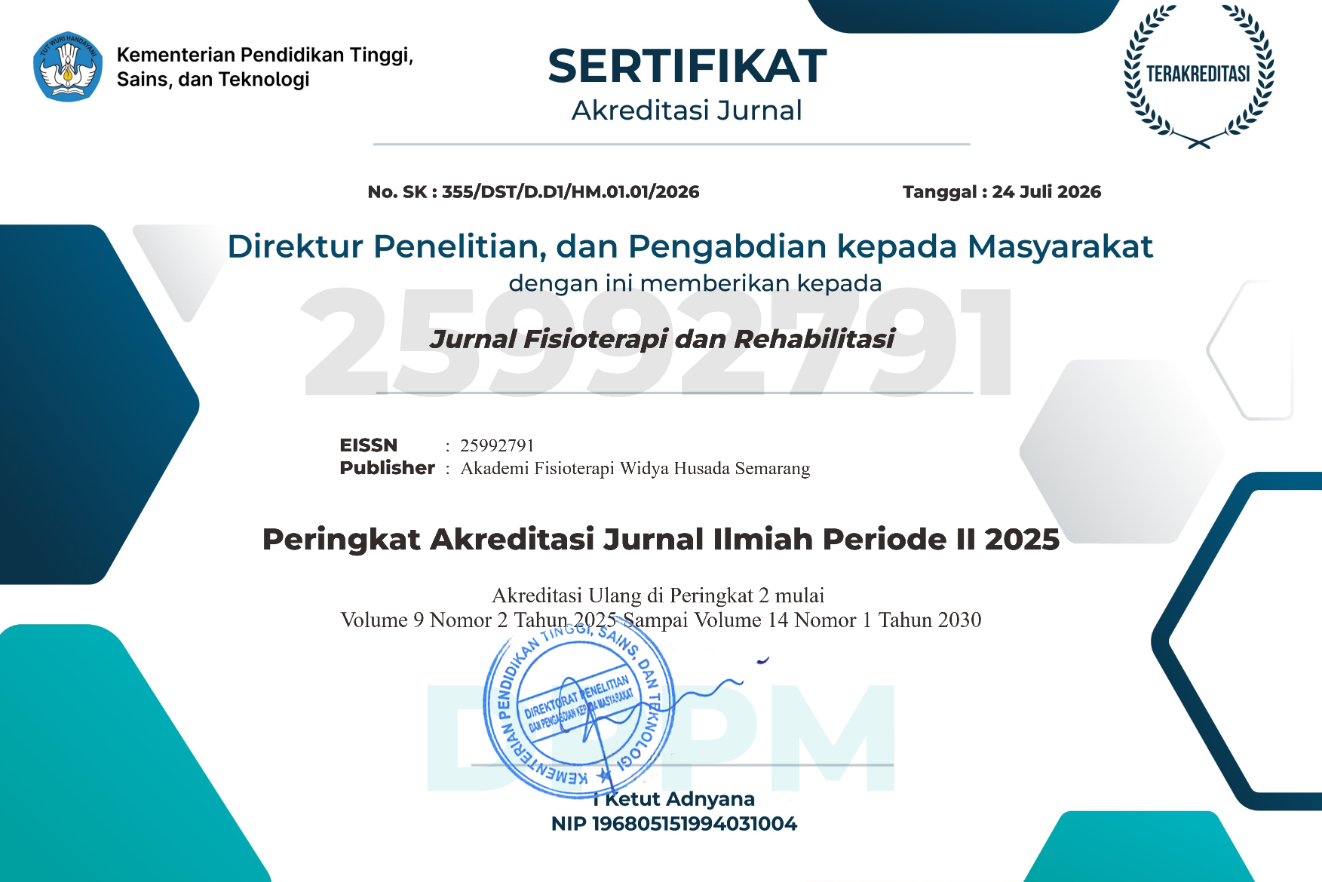
The Manajemen Fisioterapi Pada Rheumatoid Arthritis: Laporan Kasus
Physiotherapy Management in Rheumatoid Arthritis : A Case Report
Abstract
Rheumatoid arthritis (RA) merupakan penyakit autoimun kronis yang ditandai dengan peradangan sendi, nyeri, kekakuan, spasme otot, kelemahan otot, keterbatasan lingkup gerak sendi (LGS), hingga penurunan aktivitas fungsional, di mana fisioterapi berperan penting dalam mengurangi nyeri, meningkatkan mobilitas sendi, dan memperbaiki kualitas hidup pasien. Penelitian ini bertujuan mengetahui efektivitas manajemen fisioterapi dalam menurunkan nyeri, meningkatkan lingkup gerak sendi, dan memperbaiki fungsi aktivitas sehari- hari pasien dengan RA. Laporan kasus diambil dari data pasien laki-laki usia 25 tahun dengan keluhan nyeri seluruh tubuh dan keterbatasan aktivitas fungsional akibat rheumathoid arthritis , yang menjalani empat sesi intervensi fisioterapi berupa elektroterapi (IRR, interferensi), manual therapy (muscle release, friction), exercise therapy (stretching, strengthening, isotonic, static contraction, bridging, clamshell, ADL training), serta mobilisasi sendi (traksi-translasi). Evaluasi dilakukan menggunakan Numeric Rating Scale (NRS), goniometer, manual muscle test (MMT), dan pengukuran panjang tungkai. Setelah intervensi diperoleh penurunan nyeri (NRS: nyeri diam 2, nyeri tekan 6, nyeri gerak 5), peningkatan lingkup gerak sendi pada regio cervical, shoulder, hip, dan knee, serta perbaikan panjang tungkai dari 84 cm menjadi 85 cm, meskipun kekuatan otot belum menunjukkan perubahan signifikan. Manajemen fisioterapi terbukti efektif dalam mengurangi nyeri dan meningkatkan lingkup gerak sendi pada pasien RA, serta berpotensi memperbaiki fungsi aktivitas sehari-hari apabila dilakukan secara komprehensif dengan pendekatan multidisiplin.
The use of the article will be governed by the Creative Commons Attribution license as currently displayed on Creative Commons Attribution 4.0 International License.
Author’s Warranties
The author warrants that the article is original, written by stated author(s), has not been published before, contains no unlawful statements, does not infringe the rights of others, is subject to copyright that is vested exclusively in the author and free of any third party rights, and that any necessary written permissions to quote from other sources have been obtained by the author(s).
User Rights
JFR's spirit is to disseminate articles published are as free as possible. Under the Creative Commons license, JFR permits users to copy, distribute, display, and perform the work. Users will also need to attribute authors and JFR on distributing works in the journal.
Rights of Authors
Authors retain all their rights to the published works, such as (but not limited to) the following rights;
- Copyright and other proprietary rights relating to the article, such as patent rights,
- The right to use the substance of the article in own future works, including lectures and books,
- The right to reproduce the article for own purposes,
- The right to self-archive the article
Co-Authorship
If the article was jointly prepared by other authors, any authors submitting the manuscript warrants that he/she has been authorized by all co-authors to be agreed on this copyright and license notice (agreement) on their behalf, and agrees to inform his/her co-authors of the terms of this policy. JFR will not be held liable for anything that may arise due to the author(s) internal dispute. JFR will only communicate with the corresponding author.
Miscellaneous
JFR will publish the article (or have it published) in the journal if the article’s editorial process is successfully completed. JFR's editors may modify the article to a style of punctuation, spelling, capitalization, referencing and usage that deems appropriate. The author acknowledges that the article may be published so that it will be publicly accessible and such access will be free of charge for the readers as mentioned in point 3.