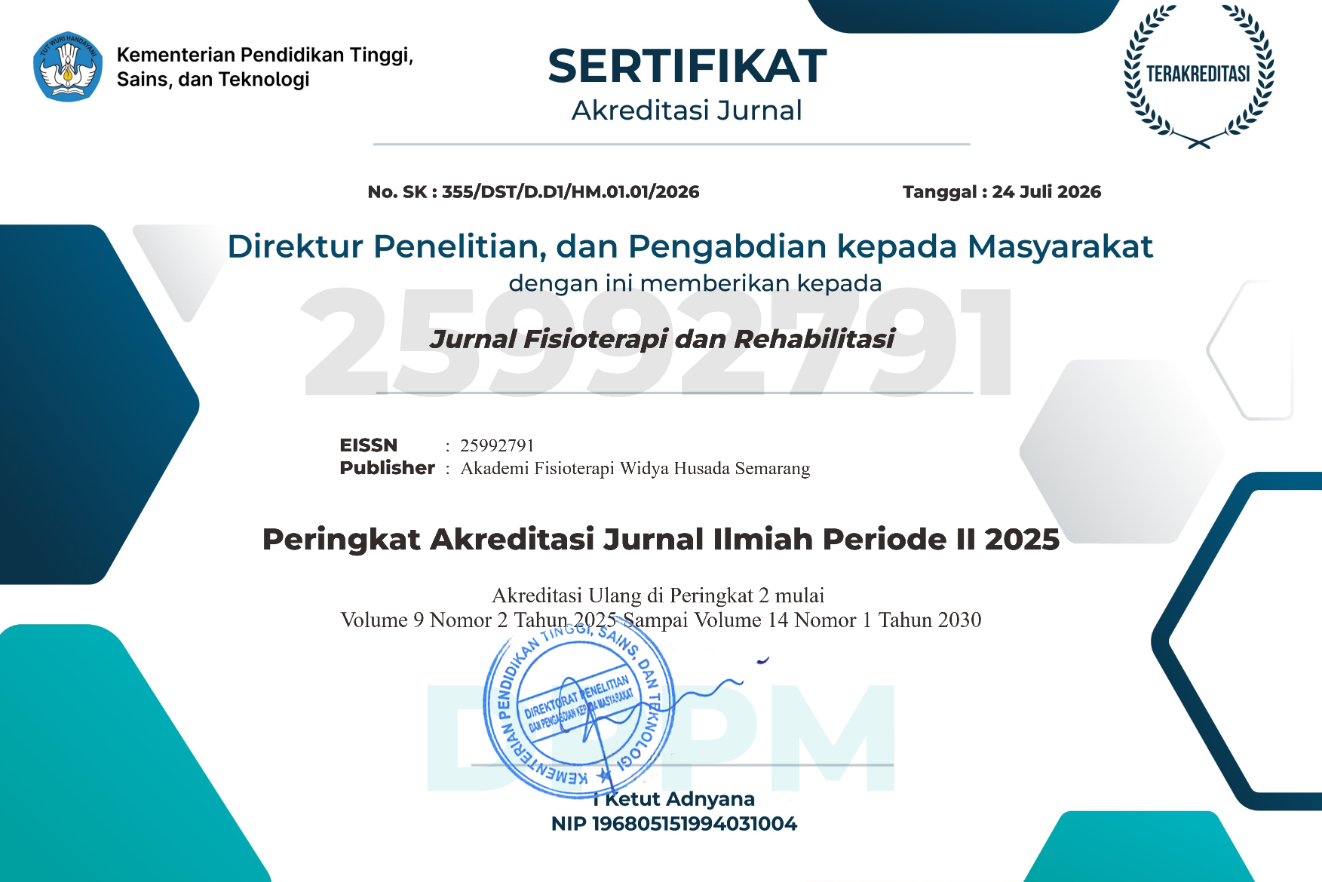
Yoga untuk Nyeri Punggung Bawah Kronis: Tinjauan Naratif tentang Efek terhadap Nyeri, Fungsi, Tidur, dan Kesehatan Mental
Yoga for Chronic Low Back Pain: A Narrative Review of Effects on Pain, Function, Sleep, and Mental Health
Abstract
Yoga merupakan praktik holistik yang menggabungkan aspek fisik, pernapasan, dan mental. Berbagai penelitian menunjukkan efektivitasnya dalam menurunkan nyeri punggung bawah kronis (Chronic Low Back Pain/CLBP), meningkatkan fleksibilitas, fungsi tulang belakang, kualitas tidur, serta mendukung kesehatan mental. CLBP sendiri adalah masalah kesehatan global dengan beban disabilitas dan biaya yang tinggi. Dalam kerangka biopsikososial, yoga dipandang sebagai intervensi tambahan yang aman, komprehensif, dan mudah diakses. Karena temuan penelitian masih heterogen, diperlukan tinjauan naratif untuk mensintesis bukti dari uji klinis teracak mengenai efek yoga pada nyeri, fungsi, tidur, dan kesehatan mental pasien CLBP, termasuk mekanisme biologis dan psikososialnya. Analisis 15 studi menunjukkan yoga efektif, aman, dan multidimensional. Yoga menurunkan nyeri, meningkatkan fungsi, serta mengurangi disabilitas dan kelelahan. Dari aspek psikologis, yoga konsisten menekan depresi, kecemasan, stres, serta meningkatkan efikasi diri dan koping. Yoga juga memperbaiki kualitas tidur, sebanding bahkan melebihi terapi fisik. Secara biologis, yoga memengaruhi regulasi saraf otonom, meningkatkan beta-endorfin, menurunkan substansi P dan kortisol, serta memperbaiki mekanisme modulasi nyeri.
References
Bağcıer, F. (2020). The Effect of Virtual Reality-based Wii Fit Yoga on Pain, Functionality and Myofascial Trigger Points in Non-spesific Chronic Low Back Pain Patients. BOĞAZİÇİ TiDergi̇si̇, 7(3), 75–81. https://doi.org/10.14744/bmj.2020.92486
Berlowitz, J., Hall, D. L., Joyce, C., Fredman, L., Sherman, K. J., Saper, R. B., & Roseen, E. J. (2020). Changes in perceived stress after yoga, physical therapy, and education interventions for chronic low back pain: A secondary analysis of a randomized controlled trial. Pain Medicine (United States), 21(10), 2529–2537. https://doi.org/10.1093/PM/PNAA150
Chen, N., Fong, D. Y. T., & Wong, J. Y. H. (2023). The global health and economic impact of low-back pain attributable to occupational ergonomic factors in the working-age population by age, sex, geography in 2019. Scandinavian Journal of Work, Environment and Health, 49(7), 487–495. https://doi.org/10.5271/sjweh.4116
Curatolo, M. (2022). Central Sensitization and Pain: Pathophysiologic and Clinical Insights. Current Neuropharmacology, 22(1), 15–22. https://doi.org/10.2174/1570159x20666221012112725
Deborah Dowell, MD1; Kathleen R. Ragan, MSPH1; Christopher M. Jones, PharmD, DrPH2; Grant T. Baldwin, PhD1; Roger Chou, M. (2022). CDC Clinical Practice Guideline for Prescribing Opioids for Pain — United States, 2022. Recommendations and Reports / November 4, 2022 / 71(3);1–95, 71.
Farley, T., Stokke, J., Goyal, K., & DeMicco, R. (2024). Chronic Low Back Pain: History, Symptoms, Pain Mechanisms, and Treatment. Life, 14(7). https://doi.org/10.3390/life14070812
Ferreira, M. L., De Luca, K., Haile, L. M., Steinmetz, J. D., Culbreth, G. T., Cross, M., Kopec, J. A., Ferreira, P. H., Blyth, F. M., Buchbinder, R., Hartvigsen, J., Wu, A. M., Safiri, S., Woolf, A. D., Collins, G. S., Ong, K. L., Vollset, S. E., Smith, A. E., Cruz, J. A., … March, L. M. (2023). Global, regional, and national burden of low back pain, 1990–2020, its attributable risk factors, and projections to 2050: a systematic analysis of the Global Burden of Disease Study 2021. The Lancet Rheumatology, 5(6), e316–e329. https://doi.org/10.1016/S2665-9913(23)00098-X
Freeman, H., Vladagina, N., Razmjou, E., & Brems, C. (2017). Yoga in print media: Missing the heart of the practice. International Journal of Yoga, 10(3), 160. https://doi.org/10.4103/ijoy.ijoy_1_17
Ge, L., Pereira, M. J., Yap, C. W., & Heng, B. H. (2022). Chronic low back pain and its impact on physical function, mental health, and health-related quality of life: a cross-sectional study in Singapore. Scientific Reports, 12(1), 1–10. https://doi.org/10.1038/s41598-022-24703-7
Groessl, E. J., Liu, L., Schmalzl, L., Chang, D. G., McCarthy, A., Chun, W. I., Sinclair, C., & Bormann, J. E. (2020). Secondary Outcomes from a Randomized Controlled Trial of Yoga for Veterans with Chronic Low-Back Pain. International Journal of Yoga Therapy, 30(1), 69–76. https://doi.org/10.17761/2020-D-19-00036
Heffner, K. L., France, C. R., Trost, Z., Ng, H. M., & Pigeon, W. R. (2011). Chronic Low Back Pain, Sleep Disturbance, and Interleukin-6 NIH Public Access. Clin J Pain, 27(1), 35–41.
Hnatešen, D., Pavić, R., Radoš, I., Dimitrijević, I., Budrovac, D., Čebohin, M., & Gusar, I. (2022). Quality of Life and Mental Distress in Patients with Chronic Low Back Pain: A Cross-Sectional Study. International Journal of Environmental Research and Public Health, 19(17). https://doi.org/10.3390/ijerph191710657
Jiang, H., Zhang, X., & Liang, J. (2024). The Combined Effect Between Sleep Disorders and Depression Symptoms on Chronic Low Back Pain: A Cross-Sectional Study of NHANES. Journal of Pain Research, 17(August), 2777–2787. https://doi.org/10.2147/JPR.S471401
Joyce, C. T., Chernofsky, A., Lodi, S., Sherman, K. J., Saper, R. B., & Roseen, E. J. (2022). Do Physical Therapy and Yoga Improve Pain and Disability through Psychological Mechanisms? A Causal Mediation Analysis of Adults with Chronic Low Back Pain. Journal of Orthopaedic and Sports Physical Therapy, 52(7), 470–483. https://doi.org/10.2519/jospt.2022.10813
Kimberley Luu, and P. A. H. (2016). Hatha Yoga and Executive Function: A Systematic Review. The Journal of Alternative and Complementary Medice, vol 22. No. https://www.liebertpub.com/doi/10.1089/acm.2014.0091?doi=10.1089%2Facm.2014.0091&utm_source=chatgpt.com
Li, W., Zhao, Y., & Xu, Z. (2021). Mekanisme Patologis Perifer dan Sentral pada Nyeri Punggung Bawah Kronis : Tinjauan Naratif. 1483–1494.
Marshall, A., Joyce, C. T., Tseng, B., Gerlovin, H., Yeh, G. Y., Sherman, K. J., Saper, R. B., & Roseen, E. J. (2022). Changes in Pain Self-Efficacy, Coping Skills, and Fear-Avoidance Beliefs in a Randomized Controlled Trial of Yoga, Physical Therapy, and Education for Chronic Low Back Pain. Pain Medicine (United States), 23(4), 834–843. https://doi.org/10.1093/pm/pnab318
Michalsen, A., Jeitler, M., Kessler, C. S., Steckhan, N., Robens, S., Ostermann, T., Kandil, F. I., Stankewitz, J., Berger, B., Jung, S., Kröz, M., & Büssing, A. (2021). Yoga, Eurythmy Therapy and Standard Physiotherapy (YES-Trial) for Patients With Chronic Non-specific Low Back Pain: A Three-Armed Randomized Controlled Trial. Journal of Pain, 22(10), 1233–1245. https://doi.org/10.1016/j.jpain.2021.03.154
Opara, J. A., Saulicz, E., Szczygieł, J. W., & Szczygieł, K. (2025). Is the Central Sensitization in Chronic Nonspecific Low Back Pain Structural Phenomenon or Psychological Reaction? A Narrative Review. Journal of Clinical Medicine, 14(2), 1–12. https://doi.org/10.3390/jcm14020577
Rae, L., Dougherty, P., & Evertz, N. (2020). Yoga vs Stretching in Veterans With Chronic Lower Back Pain and the Role of Mindfulness: A Pilot Randomized Controlled Trial. Journal of Chiropractic Medicine, 19(2), 101–110. https://doi.org/10.1016/j.jcm.2019.10.005
Roseen, E. J., Gerlovin, H., Femia, A., Cho, J., Bertisch, S., Redline, S., Sherman, K. J., & Saper, R. (2020). Yoga, Physical Therapy, and Back Pain Education for Sleep Quality in Low-Income Racially Diverse Adults with Chronic Low Back Pain: a Secondary Analysis of a Randomized Controlled Trial. Journal of General Internal Medicine, 35(1), 167–176. https://doi.org/10.1007/s11606-019-05329-4
Roseen, E. J., Pinheiro, A., Lemaster, C. M., Plumb, D., Wang, S., Elwy, A. R., Streeter, C. C., Lynch, S., Groessl, E., Sherman, K. J., Weinberg, J., & Saper, R. B. (2023). Yoga Versus Education for Veterans with Chronic Low Back Pain: a Randomized Controlled Trial. Journal of General Internal Medicine, 38(9), 2113–2122. https://doi.org/10.1007/s11606-023-08037-2
Saleem, Y., Noushad, S., Ahmed, S., & Ansari, B. (2025). Psychophysiological biomarkers for the effects of yoga as an alternative therapy among healthcare professionals with chronic low back pain: A randomized controlled trial. Journal of Nature and Science of Medicine, 8(1), 74–80. https://doi.org/10.4103/jnsm.jnsm_39_24
Tankha, H., Gaskins, D., Shallcross, A., Rothberg, M., Hu, B., Guo, N., Roseen, E. J., Dombrowski, S., Bar, J., Warren, R., Wilgus, H., Tate, P., Goldfarb, J., Drago, V. G., & Saper, R. (2024a). Effectiveness of Virtual Yoga for Chronic Low Back Pain: A Randomized Clinical Trial. JAMA Network Open, 7(11), e2442339. https://doi.org/10.1001/jamanetworkopen.2024.42339
Tankha, H., Gaskins, D., Shallcross, A., Rothberg, M., Hu, B., Guo, N., Roseen, E. J., Dombrowski, S., Bar, J., Warren, R., Wilgus, H., Tate, P., Goldfarb, J., Drago, V. G., & Saper, R. (2024b). Effectiveness of Virtual Yoga for Chronic Low Back Pain: A Randomized Clinical Trial. JAMA Network Open, 7(11), e2442339. https://doi.org/10.1001/jamanetworkopen.2024.42339
Tedeschi, R., Giorgi, F., Platano, D., & Berti, L. (2025). Classifying Low Back Pain Through Pain Mechanisms: A Scoping Review for Physiotherapy Practice. Journal of Clinical Medicine, 14(2), 1–17. https://doi.org/10.3390/jcm14020412
Vignesh, C., Rajkumar, N. C. J., Elayaraja, M., Gogoi, H., & Govindasamy, K. (2024). Effect of Selected Yoga Interventions on Psycho-Physiological Function in IT Professionals with Chronic Back Pain-A Randomized Controlled Trial. Fizicna Reabilitacia Ta Rekreacijno-Ozdorovci Tehnologii, 9(4), 256–268. https://doi.org/10.15391/prrht.2024-9(4).06
Vignesh, C., Rajkumar, N. C. J., Pramanik, M., Kumasi, B., Elayaraja, M., Bangari, D., Rawat, B., Sethi, D., Bhoria, Y., Setiawan, E., Gogoi, H., & Govindasamy, K. (2024). Effectiveness of yoga intervention on depression, stress, and sleep quality in IT professionals with chronic low back pain: A randomized controlled trial. Fizjoterapia Polska, 2024(3), 410–416. https://doi.org/10.56984/8ZG020A3TN
The use of the article will be governed by the Creative Commons Attribution license as currently displayed on Creative Commons Attribution 4.0 International License.
Author’s Warranties
The author warrants that the article is original, written by stated author(s), has not been published before, contains no unlawful statements, does not infringe the rights of others, is subject to copyright that is vested exclusively in the author and free of any third party rights, and that any necessary written permissions to quote from other sources have been obtained by the author(s).
User Rights
JFR's spirit is to disseminate articles published are as free as possible. Under the Creative Commons license, JFR permits users to copy, distribute, display, and perform the work. Users will also need to attribute authors and JFR on distributing works in the journal.
Rights of Authors
Authors retain all their rights to the published works, such as (but not limited to) the following rights;
- Copyright and other proprietary rights relating to the article, such as patent rights,
- The right to use the substance of the article in own future works, including lectures and books,
- The right to reproduce the article for own purposes,
- The right to self-archive the article
Co-Authorship
If the article was jointly prepared by other authors, any authors submitting the manuscript warrants that he/she has been authorized by all co-authors to be agreed on this copyright and license notice (agreement) on their behalf, and agrees to inform his/her co-authors of the terms of this policy. JFR will not be held liable for anything that may arise due to the author(s) internal dispute. JFR will only communicate with the corresponding author.
Miscellaneous
JFR will publish the article (or have it published) in the journal if the article’s editorial process is successfully completed. JFR's editors may modify the article to a style of punctuation, spelling, capitalization, referencing and usage that deems appropriate. The author acknowledges that the article may be published so that it will be publicly accessible and such access will be free of charge for the readers as mentioned in point 3.